
Ask any IT manager in the Philippines when they last got an alert at a sensible hour, and you will probably get a tired laugh. Attackers do not keep office hours. They move when defenders are slow to react, which usually means late nights, weekends, and the stretch of long holidays the local calendar is famous for. That timing is not random. It is a deliberate choice, and it is the reason Managed Detection and Response Services have become a serious topic of conversation for businesses across the country.
The challenge is that most local companies still run security on a daytime schedule. Tools are in place, alerts are firing, but the people who can actually act on them are off the clock for most of the week. That gap, the quiet stretch between when an attack lands and when anyone notices, is where round-the-clock detection and response coverage earns its keep.
The After-Hours Threat Reality in the Philippines
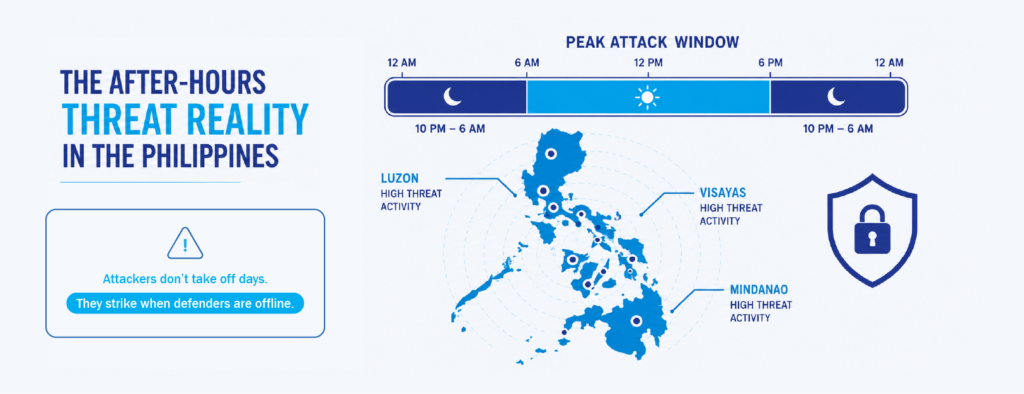
Cybercrime in the Philippines has been climbing fast. Microsoft’s Digital Defense Report has placed the country among the most targeted in the region, and Kaspersky’s regional telemetry has consistently flagged the Philippines as one of the heaviest-hit markets in Southeast Asia for business-focused malware. Local news has not been quiet either, with high-profile incidents involving government agencies, financial institutions, and retail brands becoming almost monthly headlines.
What often gets missed in those headlines is the timing. Industry research from sources like Sophos and Verizon’s annual Data Breach Investigations Report has shown for years that a large majority of ransomware detonations and serious intrusion activity happen outside of standard business hours. Attackers know that response is slower at night, on weekends, and during holidays. They count on it. The longer they can move inside a network before anyone notices, the more damage they can do.
For a Philippine business, this is a real problem. Long weekends, regional holidays, and the simple fact that most local teams work standard daytime shifts mean there are large windows each week where nobody is actively watching the environment. An alert that fires at 11 PM on a Friday may not get a serious human look until Monday morning. By then, the damage is usually done.
Why “Business Hours Security” Leaves Real Gaps
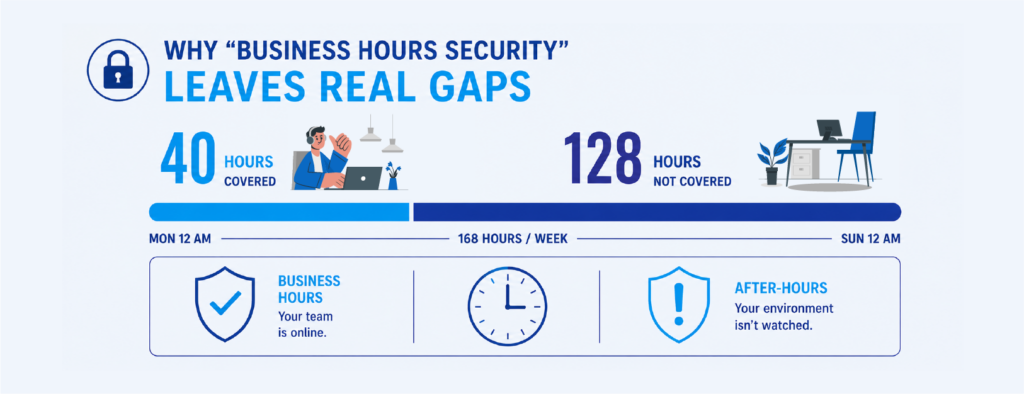
Many Philippine companies invest in solid security tools. Endpoint protection, firewalls, email security, and a Security Information and Event Management platform, often shortened to SIEM, are common parts of the stack. The tools themselves usually work fine. The gap is not the technology. The gap is who is watching it, and when.
A typical mid-sized IT team here might have one or two people loosely covering security on top of their regular duties. That coverage realistically runs from around 8 AM to 6 PM, Monday to Friday, minus lunch breaks, meetings, and the constant interruptions of helpdesk work. That leaves roughly 128 out of every 168 hours in a week with no active human attention on security alerts. Even the best Endpoint Detection and Response tool, usually called EDR, only helps if someone is reading what it surfaces.
There is also the issue of alert fatigue. When a small team comes in on Monday and sees hundreds of accumulated alerts from the weekend, the natural instinct is to triage quickly and move on. Subtle indicators of a real intrusion can easily get lost in the noise. Attackers who understand this pattern deliberately move slowly and quietly, knowing a tired analyst skimming a long alert queue is unlikely to spot them.
What Managed Detection and Response Services Actually Cover
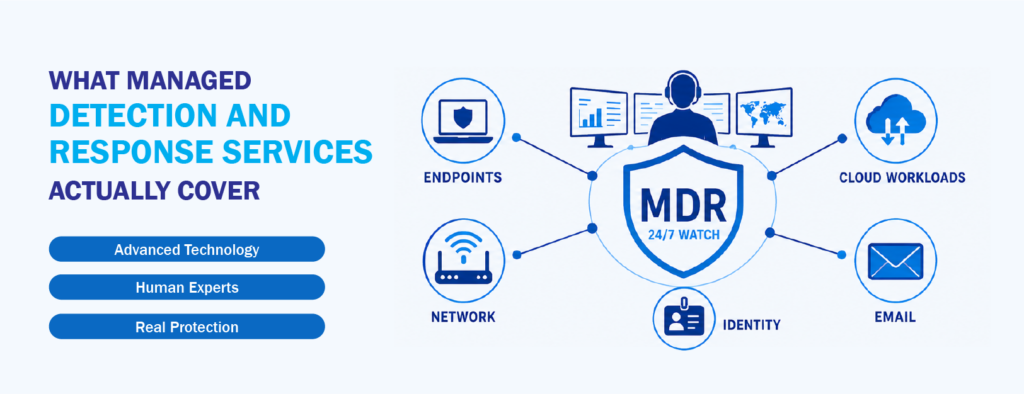
Managed Detection and Response Services, often called MDR, are essentially an outsourced security team that watches your environment around the clock. The service combines detection technology with trained human analysts who investigate alerts, hunt for threats, and take action when something real is found. The goal is not to replace your internal team but to give them coverage during the hours and days they cannot realistically be online.
A good MDR service usually pulls in data from your endpoints, network, cloud workloads, identity systems, and sometimes email. Analysts review suspicious activity in real time, separate the false positives from the real threats, and contain incidents quickly. The United States Cybersecurity and Infrastructure Security Agency, known as CISA, has consistently pointed to fast detection and response as one of the most effective ways to reduce the impact of ransomware and similar attacks. The National Institute of Standards and Technology, or NIST, makes a similar point in its Cybersecurity Framework, which treats continuous monitoring and timely response as core functions of a mature security program.
The difference between having tools and having a service watching those tools is significant. Tools generate signals. People decide what those signals mean and what to do about them. Without that human layer running continuously, even a well-equipped environment can sit exposed for hours or days during a real incident.
The Link Between Detection Speed and Breach Cost
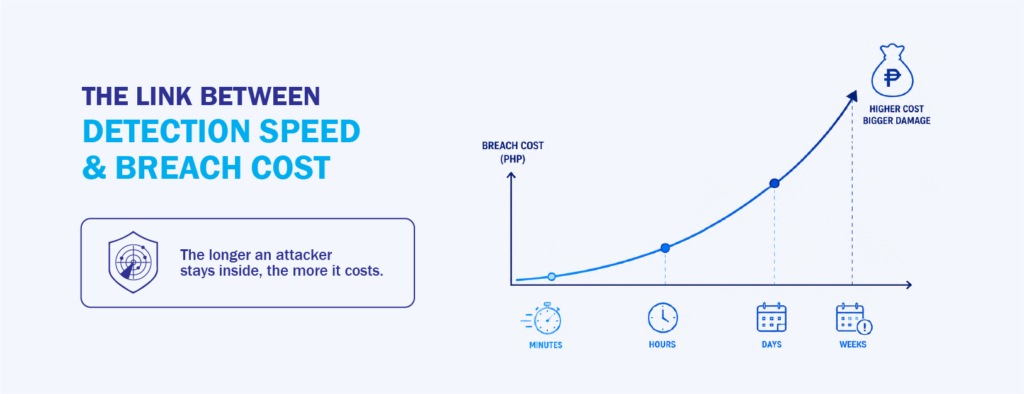
There is a strong, well-documented relationship between how fast a threat is detected and how expensive it becomes. IBM’s annual Cost of a Data Breach report has shown for several years that organizations with faster mean time to detect and respond consistently spend far less recovering from incidents than those that take weeks or months to notice. The longer an attacker stays inside, the more accounts they compromise, the more data they steal, and the more systems they encrypt.
For Philippine businesses, this matters in two ways. First, breach recovery costs in the region have been rising steadily, with average figures now reaching the hundreds of millions of pesos for serious incidents. Second, the National Privacy Commission expects organizations handling personal data to act reasonably and quickly when something goes wrong. A breach that festers for weeks because nobody noticed is much harder to explain than one that was caught and contained the same night.
Round-the-clock detection through Managed Detection and Response Services is one of the most direct ways to shrink that detection window. Catching an intrusion in minutes or hours instead of days changes the entire economics of an incident.
Where MDR Fits Inside a Managed Security Operations Center
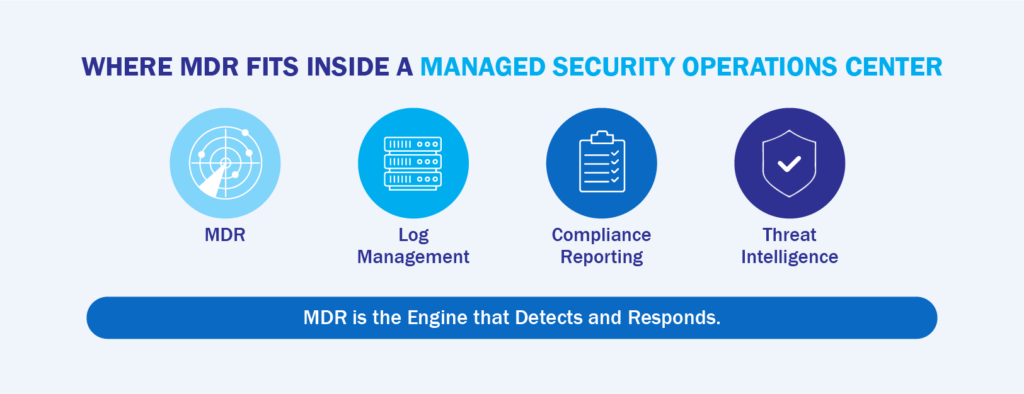
It helps to clear up where Managed Detection and Response Services sits in the bigger picture. A Managed Security Operations Center, often shortened to Managed SOC or MSOC, is a broader service that includes detection and response, but also things like log management, compliance reporting, threat intelligence, vulnerability monitoring, and longer-term security posture work. MDR is one of the core engines that drives a Managed SOC, focused specifically on finding and stopping threats.
For some companies, Managed Detection and Response Services alone is enough, especially if the priority is closing the after-hours coverage gap and you already have solid tooling in place. For others, particularly those in regulated industries or with more complex environments, a full Managed SOC makes more sense because it handles a wider range of responsibilities and provides the documentation auditors tend to ask for. The right fit usually depends on the size of the environment, the regulatory pressure the business is under, and how mature the existing security setup already is.
Either way, the underlying principle is the same. Continuous human attention on your security data, backed by experienced analysts, is what turns a pile of tools into actual protection.
Interested in learning more about Managed Security Operations Center and Managed Detection and Response Services? Contact us at marketing@ctlink.com.ph to set up a meeting with us today!