
A lot of Filipino businesses measure their security by whether they have been hacked. No breach, no problem. The trouble with that thinking is that plenty of company data ends up exposed without anyone ever touching the company’s own systems, which is the whole reason dark web monitoring exists. A password leaks from some unrelated website, an employee’s login turns up in a breach dump, and it quietly gets passed around online while everything at the office looks perfectly normal. That is the exact gap this kind of monitoring is meant to cover. It keeps a continuous watch over the hidden parts of the internet where stolen data gets traded, the forums, marketplaces, and paste sites most people never see, and it flags your organization’s information the moment it shows up, ideally while you can still do something about it.
And there is a lot to watch for. In just the first quarter of 2026, researchers tracked around 10.4 million compromised credentials linked to the Philippines, on top of more than a hundred separate breach incidents. Numbers like that tend to get read as someone else’s problem, but they are drawn straight from local data, which means a good share of it belongs to organizations operating here. The volume has been climbing, not leveling off, so it is worth understanding why exposure keeps growing and what monitoring can realistically do once your data is already out there.
What dark web monitoring actually watches for
It is worth pinning down what this actually involves, since the term gets used pretty loosely. Dark web monitoring is not a one-time scan you run and forget. It is an ongoing watch over the parts of the internet that regular search engines never touch, along with the criminal channels where stolen information gets bought, sold, and swapped. The point of keeping it continuous is that leaks do not happen on a schedule, so whenever your data surfaces, you get an alert with enough context to actually respond.
What tends to turn up is fairly consistent. Leaked credentials are the most common find, usually an employee email paired with a password that came from a breach somewhere else entirely. You will also see exposed customer or company records, stolen session tokens that let an attacker walk straight past the login screen, and signs that your brand or a senior staff member is being lined up for a scam. The reason this matters is that none of it would ever appear in a scan of your own network. The data is sitting on someone else’s server, in a place you have no visibility into, which is precisely why monitoring exists in the first place.
Three reasons local exposure keeps growing
1. More Filipino data is being breached and traded
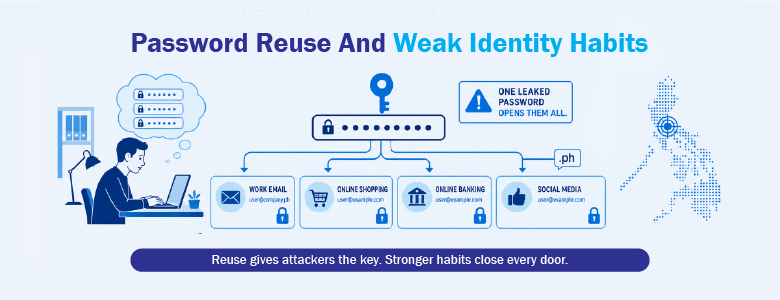
Start with the obvious one, which is sheer volume. There is simply more Philippine data floating around criminal markets than there used to be. Beyond those millions of compromised credentials logged in early 2026, separate reviews of 2025 counted hundreds of breach incidents exposing an enormous number of records tied to the country. Each of those breaches quietly feeds the same underground economy, where a valid login is treated as a product with a going rate.
The part that catches people off guard is how long that data stays useful. A password that leaked two years ago can still work today if nobody bothered to change it, so old dumps get resold, repackaged, and tried again against fresh targets long after the original breach. That is actually where monitoring pulls its weight. It is not only about catching new leaks as they happen but also about surfacing older exposures that resurface, which gives you a chance to close a door you probably assumed was shut ages ago.
2. Password reuse and weak identity habits
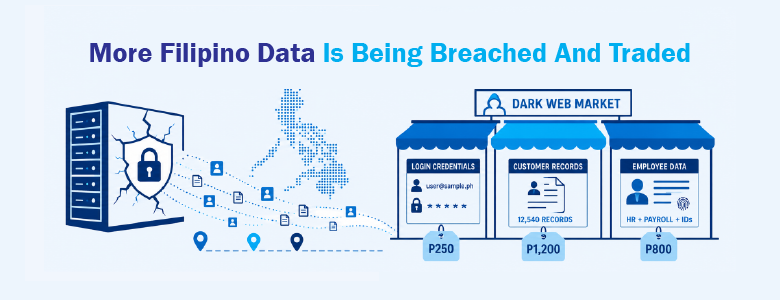
The next reason has less to do with attackers and more to do with ordinary habits. People reuse passwords, and they do it constantly. The same login someone set up for a random shopping site is very often the one guarding their work email, so when that shopping site gets breached, the credential lands on the dark web and an attacker suddenly holds a key that has already been tested. Running stolen username and password pairs across dozens of sites to see what opens is one of the most common routes to a hijacked account.
This is what makes leaked credentials so dangerous, especially in a setting where security habits are still catching up to the threat. A single reused password can quietly undo a lot of expensive protection sitting elsewhere in the business. Monitoring gives you an early heads-up that a specific credential is circulating so it can be reset before anyone puts it to use, and it works best alongside stronger identity controls. That is a big part of why so many organizations are shifting toward passwordless and multi-factor setups, which make a stolen password far less useful on its own.
3. Supply chain and third-party exposure
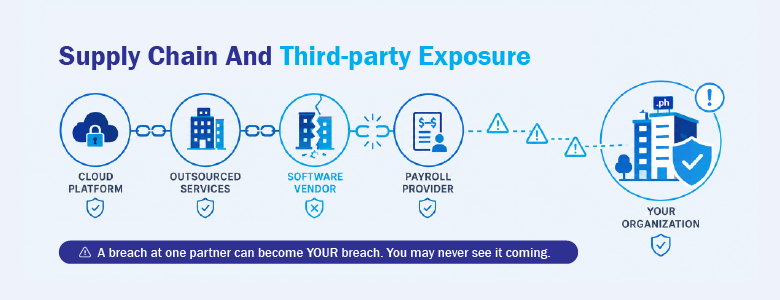
The third reason is that your exposure no longer stops at your own front door. Filipino businesses depend heavily on outside vendors, cloud platforms, and outsourced services, and every one of those connections is a place data can slip out. If a supplier gets breached, your information, or the access they hold into your systems, can end up exposed even when your own defenses held up perfectly. Reports across 2025 and 2026 have flagged supply chain and third-party breaches again and again as some of the most damaging incidents hitting organizations in the region.
The awkward part is that this risk is nearly impossible to see from the inside, because you were never in control of the vendor’s security to begin with. What you can do is keep an eye out for the aftermath. Monitoring widens your view to cover your broader digital footprint, including credentials and data that leak through partners, so a third party’s bad week does not turn into your silent breach. This sits inside the wider practice of external risk management, which is really about seeing everything an attacker can reach, not just the systems inside your own walls.
How stolen data moves from breach to real attack
It helps to follow the path a single leaked record travels, because that timeline is where monitoring proves its worth. The breach usually happens somewhere you have never dealt with directly. The stolen data then gets bundled up and either sold or dumped in the open. From there, criminals start testing those credentials, hunting for reused passwords, and probing for a way into something more valuable. Only at the very end does any of it turn into an account takeover, a fraudulent transfer, or a genuine intrusion.
That stretch between the first leak and the eventual attack is the window you get to work with, and it can run anywhere from a few days to several months. Dark web monitoring is what turns that window into a warning instead of an ambush. Guidance from organizations like CISA and NIST keeps returning to the same point, that early detection and a quick credential reset go a long way toward limiting the damage, and monitoring is one of the more practical ways to actually live up to that advice rather than finding out the hard way.
Where dark web monitoring fits in the bigger picture
For all its usefulness, monitoring is not a fix on its own, and it would be a stretch to pitch it as one. It tells you what is exposed, but it will not patch a system or reset an account for you. Where it genuinely shines is as an input to the rest of your security, handing your team a clear prompt they can act on using the tools already in place. Picture it as the early-warning layer that makes everything after it move a little faster.
For the same reason, a clean result is never a promise that you are in the clear. Nothing found today only tells you nothing was visible today, and new breaches keep landing all the time, so the real value lives in the steady, ongoing watch rather than any single check. Looked at that way, as a continuous stream of early signals instead of a once-a-year audit, monitoring turns into one of the more sensible investments a growing organization can make against a problem that shows no sign of easing up.
Interested in learning more about dark web monitoring and solutions that carry it like Check Point ERM? Set up a consultation with us today through marketing@ctlink.com.ph.