
For most of the last two decades, security has been built around one goal: keep the bad guys out. Firewalls filter traffic, antivirus blocks known threats, and email gateways screen out the obvious scams. All of it is useful, and none of it should go away. The trouble is that prevention alone has a ceiling. Attackers only need to find one gap, and with phishing and stolen passwords doing so much of the work these days, someone eventually slips through. This is exactly the blind spot that deception technology was made to cover, because when an intruder does get in, the uncomfortable reality is that they often go unnoticed for weeks while they quietly look around for something worth stealing.
That blind spot is where a different way of thinking comes in. Deception technology does not try to add another wall. It assumes someone will get in, then sets quiet traps that give the intruder away the moment they start snooping. You scatter believable fake systems across your network, and because no legitimate staff member has any reason to touch them, the only people who ever do are the ones who should not be there. For a lot of businesses here in the Philippines, this idea is still unfamiliar, so it is worth walking through what it is, where it came from, and why a decades-old concept is suddenly getting attention again.
The Simple Bait-and-Alert Idea Behind a Honeypot
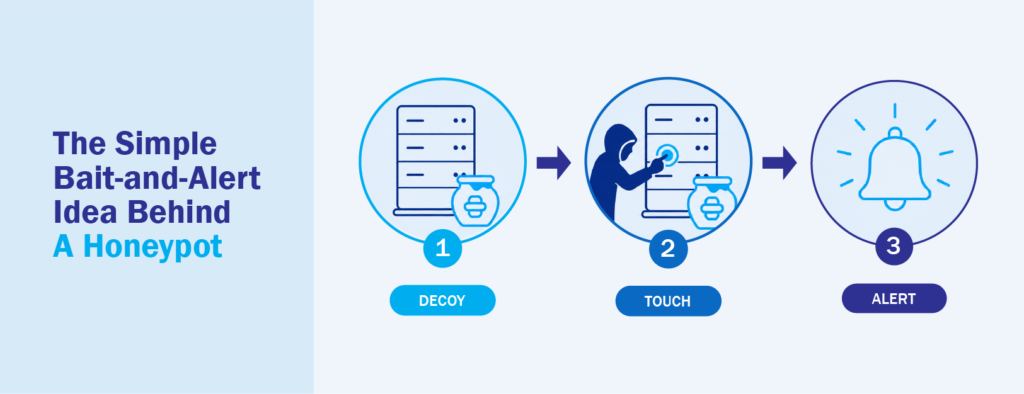
A honeypot is a decoy, and it is the foundation that deception technology is built on. It looks like a real server, a real database, or a real file share, but it holds nothing of value and serves no purpose for your staff. Because no legitimate user has any reason to open it, any interaction with that decoy is suspicious by default. Security researchers have used honeypots for years to study how attackers behave, and reputable sources like Kaspersky and Fortinet still describe them as one of the most reliable ways to spot intruders who have slipped past the front door.
The appeal is how little guesswork is involved. A firewall has to decide whether traffic is good or bad. Antivirus has to match a threat against a known signature. A honeypot skips all of that. If someone is poking at a system that should never be touched, that alone tells you something is wrong. There is very little noise, and the signal that does come through tends to be worth your attention.
Where Traditional Honeypots Earned a Bad Reputation
If honeypots are so useful, why did most companies never bother with them? The honest answer is that the early versions were a hassle. Setting one up often meant standing up a separate machine, configuring services by hand, and babysitting it so it stayed convincing. Teams that were already stretched thin looked at all that effort and quietly decided it was a project for someone else, someday.
There was also a fear factor. A poorly built honeypot could become a liability, giving an attacker a real foothold instead of a dead end. So the tool that was supposed to help sometimes created new problems. For years, that reputation kept honeypots in the world of researchers and large enterprises with dedicated staff, rather than everyday businesses.
How Deception Technology Fixed Those Pain Points
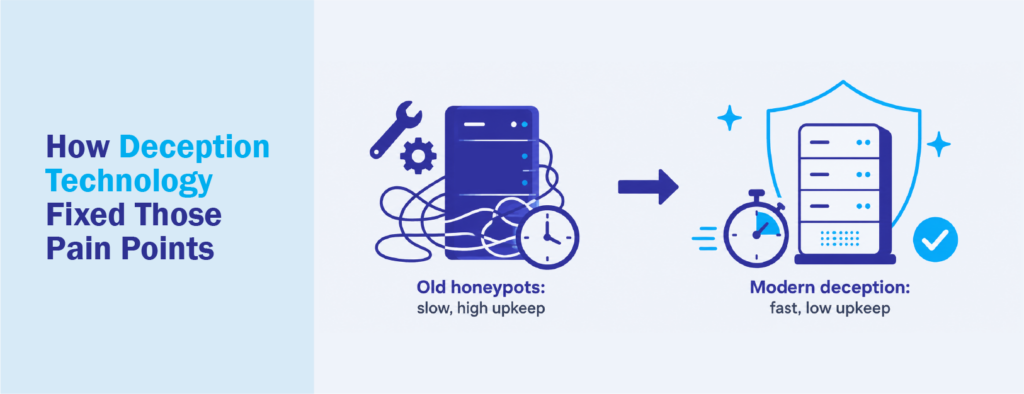
Modern deception technology is really the honeypot idea rebuilt for people who do not have hours to spare. The decoys are pre-configured, so you are not assembling anything from scratch. They deploy in minutes, they need almost no maintenance once they are running, and they are designed to be isolated so they cannot be used as a stepping stone into your real environment. The old trade-off between usefulness and upkeep has mostly gone away.
This is where the shift matters most for lean IT teams. You get the early-warning benefit of a honeypot without the ongoing care and feeding that made the old approach impractical. Guidance from organizations such as CISA and NIST has long encouraged layered detection and faster incident response, and deception technology fits neatly into that thinking. It is a detection layer that runs quietly in the background and only speaks up when it has something real to say.
Decoys That Look Like the Real Thing
The whole strategy falls apart if the traps look fake, so a lot of engineering goes into making decoys believable. A single decoy can present itself as a Windows file server, a network router, or a Linux web server, complete with the kinds of services an attacker would expect to find, like file shares, remote access, or a login page. Placed next to your genuinely sensitive systems, it acts as a tripwire for the sideways movement attackers rely on once they are inside.
Some tools extend this idea beyond full systems using lightweight tokens. These are small tripwires you can tuck inside documents, folders, or cloud accounts. If someone opens a file they were never meant to see, you get an alert with details about what happened. It is a low-effort way to spread coverage into places a traditional honeypot could never reach.
Why Almost Every Alert Is Worth Reading

Alert fatigue is a real problem. Many security platforms throw off thousands of notifications a day, and the overwhelming majority are false alarms. Over time, people stop looking, and the one alert that actually mattered gets buried. This is one of the quiet reasons breaches go undetected for weeks, a pattern noted repeatedly in major cybersecurity research reports.
Deception flips that math. Since a decoy has no legitimate use, an alert from it is almost always a genuine signal. A good alert also tells you what you need to act on: the source address, which service was touched, and what the intruder tried to do. That context can be delivered by email, SMS, or straight into the tools your team already uses, so it slots into your existing workflow instead of replacing it. Fewer alerts, more meaning, is a fair way to sum it up.
Where Deception Technology Fits for Businesses in the Philippines
Local threat activity has grown noticeably. Reporting through 2026 has tracked a steady rise in phishing, ransomware, and data breaches hitting Philippine finance, logistics, and critical services, and a common thread is that attackers often sit inside a network undetected for a long stretch before doing damage. Deception technology is aimed squarely at that gap. It is less about stopping the initial break-in and more about catching the intruder early, while they are still looking around.
That fit is especially useful for organizations without a large security team. You do not need a full security operations center to benefit from a decoy that pings you the moment it is touched. It is a practical, low-overhead layer that gives smaller teams a fighting chance at spotting trouble before it turns into a headline.
A modern example of this approach is Thinkst Canary. It is built so a decoy can be deployed across on-premises, virtual, or cloud environments in a matter of minutes, then managed from a single console. It captures the early-warning value of deception without the complexity that scared people off in the past, which makes it an approachable way into a category most teams have never tried. For anyone curious about where to begin, it is one of the friendlier names to look at first.
A Reasonable Way to Think About It

Deception technology is not a replacement for the security you already run. Your firewall, endpoint protection, and monitoring tools all still have a job to do. What it adds is a clean, high-confidence signal for the times something gets through anyway, which, realistically, will happen eventually. It is a safety net for the assumption every honest security plan should make.
If you are weighing whether deception technology belongs in your setup, six things are worth keeping in mind:
- It starts from the assumption that someone will eventually get in, and focuses on catching them fast rather than only keeping them out.
- A honeypot is simply a decoy that no legitimate user should ever touch, so any interaction with it is a red flag.
- The old versions were high-maintenance and a little risky, which is why they never caught on widely.
- Modern deception fixes that, deploying in minutes with almost no upkeep and no easy path back into your real systems.
- Because decoys have no real use, nearly every alert they raise is a genuine signal worth acting on.
- It complements the tools you already have instead of replacing them, filling the specific gap of spotting intruders already inside.
Get those points straight and the rest of the conversation becomes a lot easier. The technology that used to be too fiddly for everyday use is now quick to set up and quiet to run, and it answers a very specific question that other tools struggle with: is there someone moving around inside my network right now? A trustworthy answer to that is worth a great deal.
To learn more about deception technology and honeypot solutions like Thinkst Canary, contact us at marketing@ctlink.com.ph to schedule a meeting with us today!