
When you shop for storage, it is easy to assume the drives inside every all-flash array are basically the same. You line up the spec sheets, compare the numbers, and pick whatever looks best for the price. But the way a system actually uses its flash matters just as much as the flash itself. That one design decision quietly shapes your cost, your density, and how many years your hardware stays worth keeping. So before you sign off on another set of enterprise SSD drives, it helps to know what is really going on behind that label.
That is the gap EverPure, formerly Pure Storage, set out to address with its DirectFlash technology. Most vendors buy finished drives and slot them in, while EverPure took a different route and builds its own flash devices that talk straight to the memory. It sounds like a small engineering detail, but it changes how the whole system behaves. Let us walk through what that actually means for your business, in practical terms.
What “Enterprise SSD Drives” Really Are
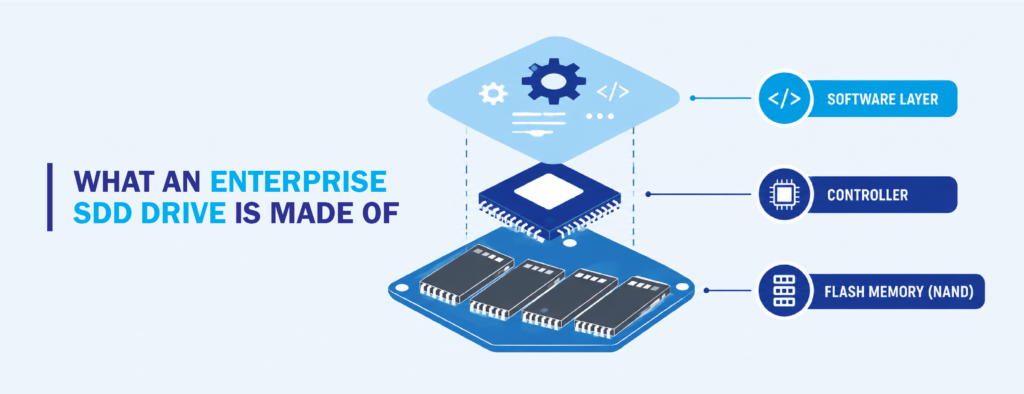
A solid-state drive is a storage device built from flash memory chips, a controller, and a layer of software that keeps everything organized. Enterprise SSD drives are the industrial-strength versions of the drive in your laptop. They are made for data centers, built to handle nonstop reading and writing, and rated to take far more wear over their lifetime than anything in a consumer machine. If your business runs databases, virtual machines, or heavy workloads, this is the tier you are shopping in.
Here is the part that surprises people. Most storage vendors do not make their own drives. They buy commodity off-the-shelf SSDs from disk suppliers and drop them into their arrays. Those drives were originally designed to imitate an old spinning hard disk, presenting themselves as one long list of identical blocks. To do that, every SSD carries an internal translator called a flash translation layer, or FTL. It sits between your system and the real memory, working in the background so the drive behaves the way the software expects.
That translator is useful, but it comes at a price. It adds delay, it uses power, and it hides what is really happening inside the flash from the system that is supposed to be managing it. For a long time, that was simply the cost of using SSDs, and most vendors accepted it.
The SSD Trap, and Why It Quietly Costs You

The “SSD trap” describes what happens when vendors keep fitting generic drives into enterprise systems. You inherit the limitations of a commodity part, including its efficiency ceiling, its warranty terms, and the extra layers it needs just to function. Put simply, your array can only be as good as drives that were designed by someone else for a different purpose.
The point EverPure makes is that this trap is optional rather than inevitable. Building the flash device differently can produce more compact, less costly systems over time, and that gap is not trivial. When efficiency compounds across a full data center, you feel it in your power bill, in how much rack space you use, and in how soon you are pushed into another refresh. For a growing business in the Philippines, where floor space and power are rarely cheap, those numbers add up quickly.
Enter DirectFlash Modules: Talking Straight to Raw Flash
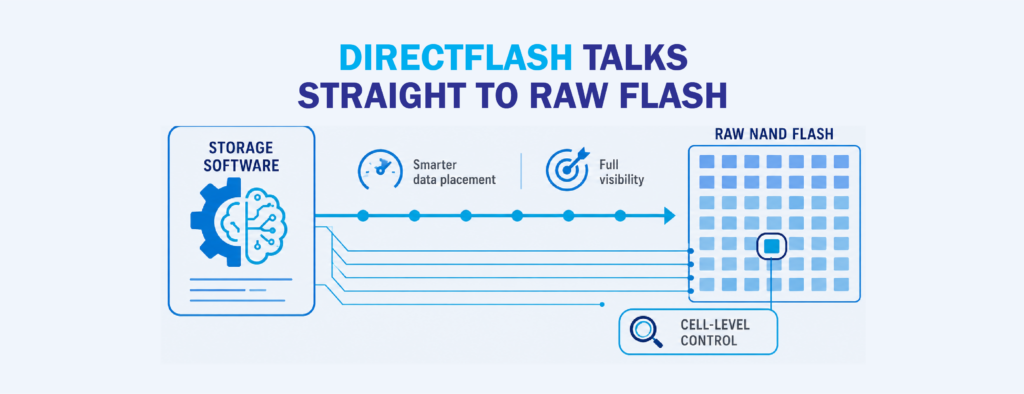
DirectFlash Modules, or DFMs, are EverPure’s approach to that problem. Instead of buying finished SSDs, EverPure sources raw NAND flash memory and builds the device itself, so the array talks directly to the flash without a translation layer in the middle. The storage software decides how data gets placed and how the memory wears, rather than handing that job to a small controller buried inside each drive.
This shift from drive-level control to system-level control is the core idea. Because the system can see down to individual flash cells, it can make more informed choices about where data lives and how to keep performance steady as the array fills up. There is no middleman making decisions the rest of the system cannot see. Compared to a standard SSD, even a high-end enterprise one, that is a different way of building storage.
The difference also shows up in capacity. While disk vendors ship drives around 15.72TB in volume, EverPure has shipped 75TB and 150TB modules, with larger sizes on its roadmap. More capacity in the same footprint means you can fit more workloads onto fewer systems, which helps when you are trying to grow without adding another rack.
5 Ways DirectFlash Differs From Standard Enterprise SSD Drives
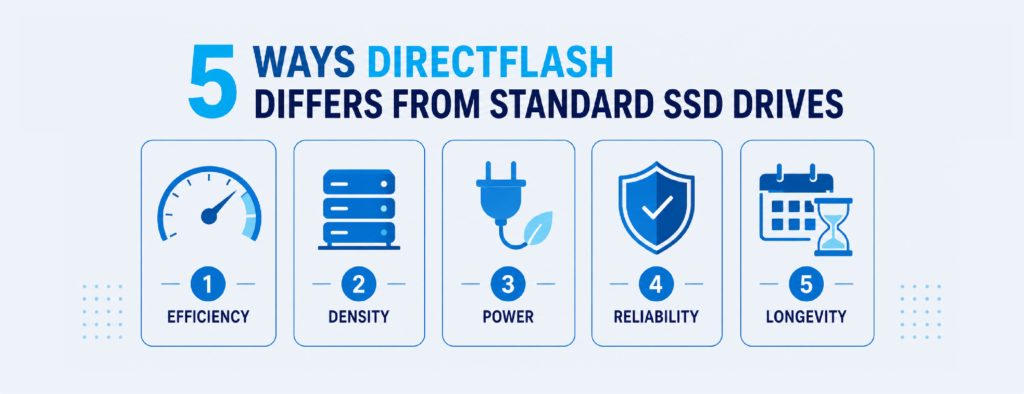
When you compare DirectFlash to a conventional enterprise SSD drives setup, five practical differences tend to stand out. These are the areas worth weighing during a refresh, because they affect what you actually spend and how long the hardware holds up.
- Efficiency. Because the modules are purpose-built rather than generic, they use flash more efficiently, which helps bring down the cost per usable terabyte.
- Density. With capacities reaching 75TB and 150TB per module, you can fit far more storage into the same rack space than typical drives allow.
- Power. Talking directly to the flash removes a layer of overhead, and that tends to lower the watts drawn per terabyte compared with traditional designs.
- Reliability. Managing the flash at the system level rather than the drive level can reduce failure rates, which means fewer disruptions down the line.
- Longevity. Longer endurance ratings and warranty coverage mean the investment holds its value for more years before a replacement makes sense.
What ties these together is the underlying approach. When the flash device and the software that runs it are designed as one system, there is less need to work around the limits of a part built for a different purpose.
What This Means for Your Refresh Decision
The good news is that none of this asks you to become a flash engineer. The practical takeaway is that two arrays with nearly identical spec sheets can behave very differently once they are running, and the difference often comes down to whether the vendor engineered its own flash or bought it off the shelf. Efficiency, density, and endurance are not marketing extras. They decide how much you spend on power, how often you are back in the market for hardware, and how much room you leave yourself for growth.
The reason this matters is that storage is a long commitment. An array you buy today will likely sit in your rack for years, quietly running up power and cooling costs the whole time and setting a hard limit on how much you can grow before you need more space. A drive that looks a little cheaper on day one can end up costing more across that stretch if it draws more power, fills up faster, or wears out sooner. That is why the design underneath is worth a look, not just the headline capacity and price.
Bringing EverPure Into a PH Environment
Picking the right storage is one thing. Deploying it cleanly, sizing it for your workloads, and keeping it healthy afterward is another. That is where a local partner helps. As an EverPure partner in the Philippines, CT Link works with businesses to match DirectFlash-based arrays to real requirements, plan the migration without disrupting daily operations, and provide support close to home.
So if an all-flash refresh is on your roadmap, it is worth a conversation before you commit to another cycle of commodity enterprise SSD drives. Getting the architecture right at the start is usually cheaper than working around its limits for years.
Interested in learning more about Enterprise SSD drives and EverPure? Contact us at marketing@ctlink.com.ph to schedule a consultation with us today!